The Petrodollar Uncertainty and the Asian Century: Geopolitics and Nepal—From 'Black Gold' to the 'Electric Revolution'
Sunil Karki,
Published 2026 Mar 21 Saturday
For the past century, a single liquid has controlled the world map, economy, and politics: petroleum, also known as "Black Gold." However, the oil empire that held the world in its grip for generations—and the monopoly of the US Dollar built upon it—is now facing its greatest crisis in human history.
In 1938, after an American company discovered vast oil reserves in the deserts of Saudi Arabia, the Middle East became the epicenter of global geopolitics. Towards the end of World War II, in 1945, a secret agreement was reached between US President Franklin D. Roosevelt and Saudi King Ibn Saud aboard the American warship USS Quincy. The deal was clear: America would provide military protection to the Saudi royal family, and in exchange, Saudi Arabia would provide America with affordable oil.
Photo : AI Generate
However, the real "game-changer" for the global economy occurred in 1971. US President Richard Nixon abolished the "Gold Standard," the system where dollars could be exchanged for gold. As the risk grew that the dollar would become merely a "piece of paper," the US made a shrewd economic deal with Saudi Arabia in 1973-74. Saudi Arabia (and OPEC nations) agreed to accept only the "US Dollar" for oil sales worldwide. This became known as the Petrodollar. Since every country needed oil and needed dollars to buy it, the United States established its hegemony over the global economy simply by printing currency.
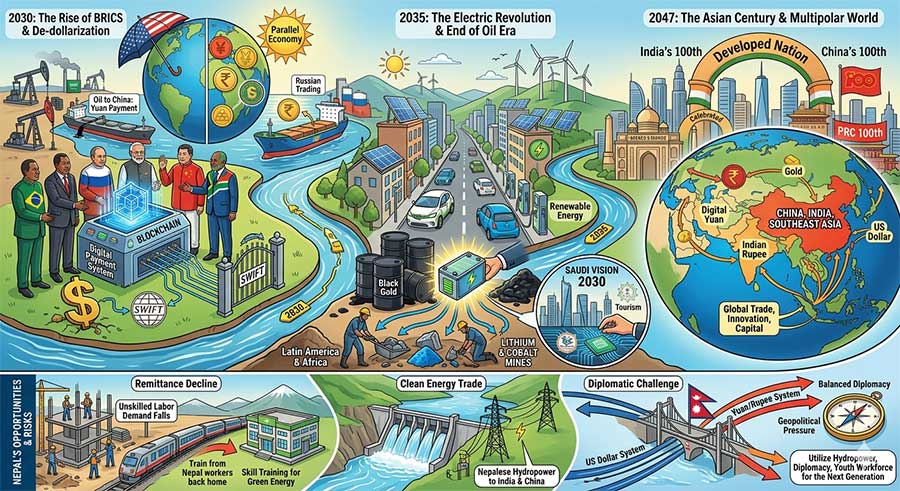
2030: The Fall of the Petrodollar and the Rise of BRICS
For 50 years, the dollar’s monopoly continued undisturbed. However, the world was jolted when the US began using the dollar as a political weapon to freeze the assets of countries it disliked (such as Iran and Russia). This fear gave birth to De-dollarization—the campaign to find an alternative to the dollar.
By 2030, the world economy will no longer sit under a single dollar umbrella. The BRICS alliance—comprising Brazil, Russia, India, China, and South Africa—now includes major oil producers like Saudi Arabia, the UAE, and Iran. Today, China has already begun paying for Saudi oil in the Chinese "Yuan," while India is trading with Russia in its own "Rupee." It is projected that by 2030, BRICS nations will have fully implemented their own independent "Digital Payment System" based on blockchain, bypassing the dollar and the US-controlled SWIFT system. The world is entering an era of a "parallel economy."
2035: The End of the Oil Era and the 'Electric Revolution'
The year 2035 will be another major turning point in global geopolitics. The European Union, China, and several US states have already passed laws to ban the sale of petrol and diesel vehicles by 2035. When only Electric Vehicles (EVs) roam the streets, the demand for Middle
Eastern oil will see a historic decline.
A drop in oil demand means the breaking of the "Petrodollar" cycle. Recognizing this "existential crisis," Saudi Arabia is currently shifting its economy from oil toward technology and tourism through "Vision 2030." After 2035, the strategic battlegrounds will move from Middle Eastern oil fields to the lithium and cobalt mines (used for batteries) in Latin America and Africa. The source of energy will shift from beneath the ground to the sun and wind (renewable energy).
2047: A Multipolar World and the 'Asian Century'
The year 2047 marks the 100th anniversary of independence for Nepal’s neighbor, India, where it aims to become a fully developed nation. Two years later (in 2049), the People's Republic of China will reach its 100th anniversary. By 2047, the United States will no longer be the world's sole "Superpower."
In international trade, the US Dollar, the Digital Chinese Yuan, the Indian Rupee, and Gold will operate in parallel. Asia, which was the center of the world economy until the 18th century, will return to its former glory after nearly 300 years. More than half of global trade, innovation, and capital will revolve around China, India, and Southeast Asia. This will be, in every sense, the Asian Century.
New Opportunities and Risks for Nepal
This global upheaval is not just international news for Nepal; it is a matter tied to our own kitchens and economic future.
First, the impact will be on remittances. As oil demand falls, infrastructure construction in Middle Eastern countries will slow down, leading to a sharp decline in the demand for "unskilled labor" from Nepal. This will force Nepal to retain its workforce at home and provide skill-based training in "green energy" and technical sectors.
Second is the opportunity in clean energy trade. As the world moves away from fossil fuels, Nepal’s "hydropower" will become invaluable. Situated between the two major engines of the Asian Century—India and China—Nepal will have an unprecedented opportunity to achieve economic sustainability by selling its electricity.
Third, and the most challenging aspect, will be diplomacy. As the dominance of the dollar wanes, Nepal will face increasing pressure to use the Yuan and Rupee directly in trade with China and India. While this might reduce inflation by saving on currency exchange losses, the risk of Nepal getting caught in a geopolitical squeeze remains high if it fails to balance the two different economic systems (the West and BRICS).
History has taught a clear lesson: nations that fail to hear the footsteps of time fall behind. Yesterday, desert nomads became masters of the world by understanding the value of oil. Today, as the world moves from "Black Gold" to "Electric Batteries" and economic power shifts from Wall Street to Asia, Nepal cannot afford to remain a mere spectator. How Nepal utilizes its hydropower, diplomacy, and youth workforce in this changing world order will determine the future of our next generation.